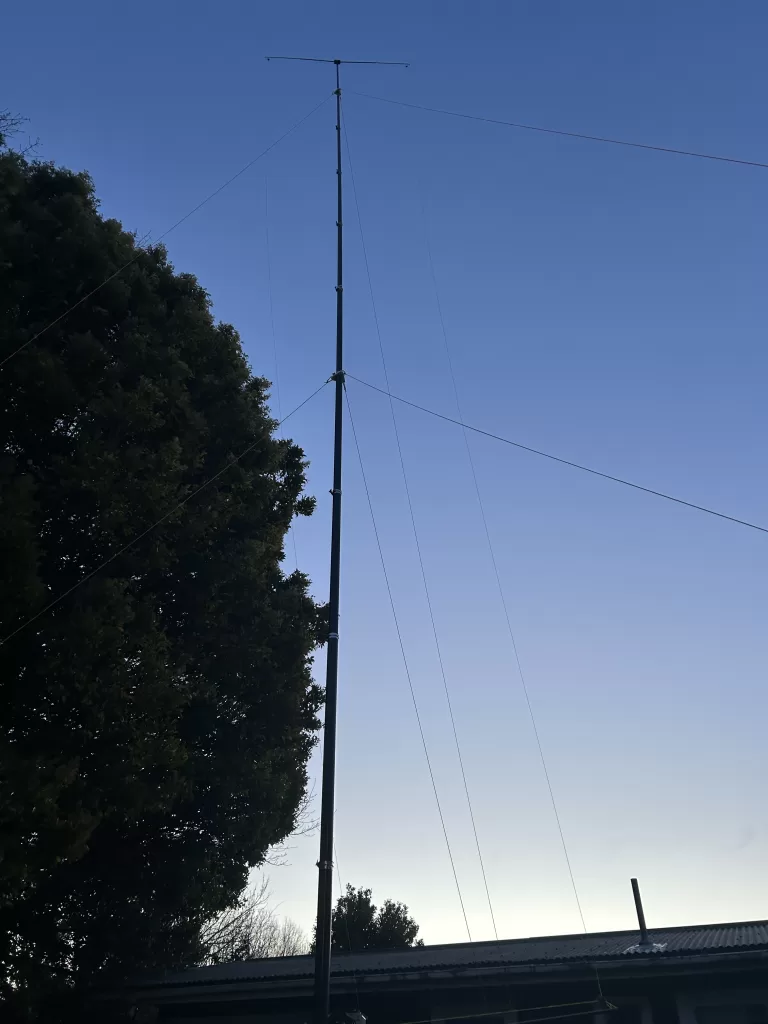
The use of extendable poles constructed of carbon fibre / fibreglass reinforced epoxy, especially for portable antenna use is growing rapidly, especially given the improving affordability. The tubular poles are typically made up of a number of concentric sections with a slight clearance between sizes. This results in the sections nesting inside of each other when the pole is collapsed. Each section has a tapering slightly larger external diameter at their “lower” end and a tapering slightly narrower internal diameter at their upper end. When a section is nearly fully extended, the tapering parts between two pole sections engage and lock the smaller section from being totally withdrawn from the larger section. This friction locking provides for the pole to hold it’s extension. Or does it?
This is a work in progress!
But before we answer that, a word about poles. Fibreglass poles have practically been replaced by carbon-fibre types. For amateur portable use, weight is probably the most significant factor. Carbon fibre is much lighter, as it can be constructed to a much thinner wall size for a given strength. While there are poles marketed specifically for amateur radio, there are some very economic alternatives available, designed for fishing or fruit harvesting! The fishing types, commonly known as “squid” poles, have a very small outside diameter [OD] top section and typically for antenna use, the top 2 or 3 sections might be discarded. This is owing to extreme flexing, or even potential breakage, when used to support antennas. These poles are available in lengths up to around 12m. The “harvesting” or “retrieval net” pole, has a much larger OD top section to accomodate a tip mounted ferrule with an internal thread (typically M8), for attachments. This design is intrinsically more stable and the screw thread is extremely useful for attaching antenna related fittings. – how convenient! These poles are available up to 22m in length. Even with a reasonably large diameter top section, carbon-fibre poles do have quite some degree of flex and guy ropes may be required, depending on pole height and antenna loading.
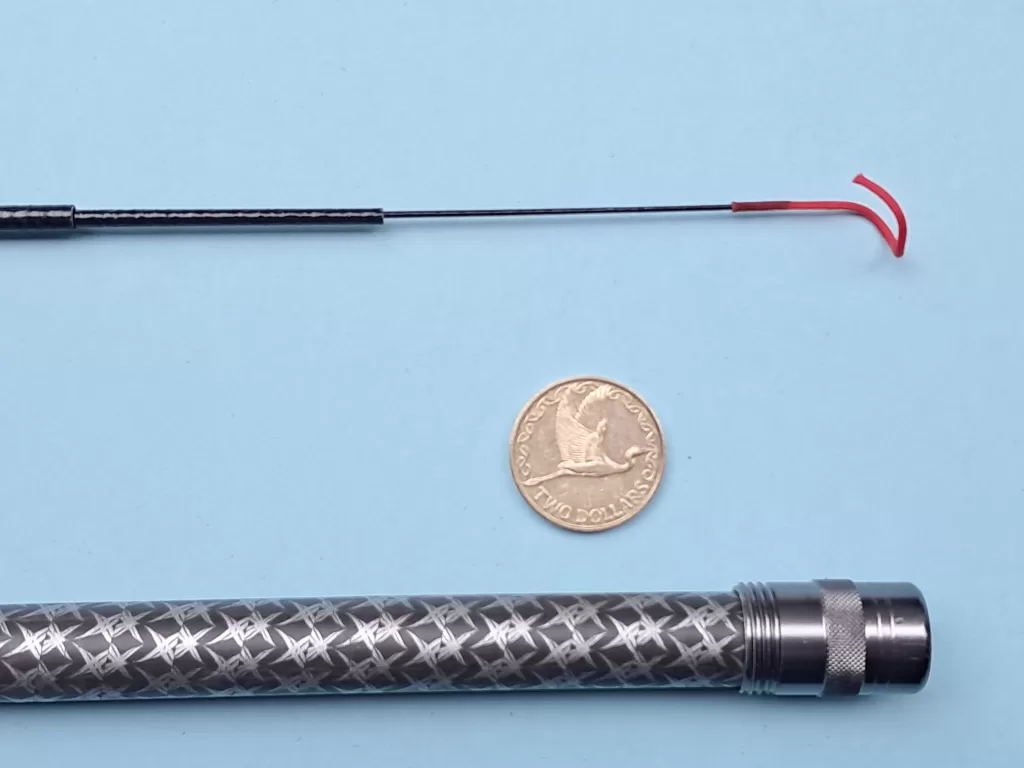
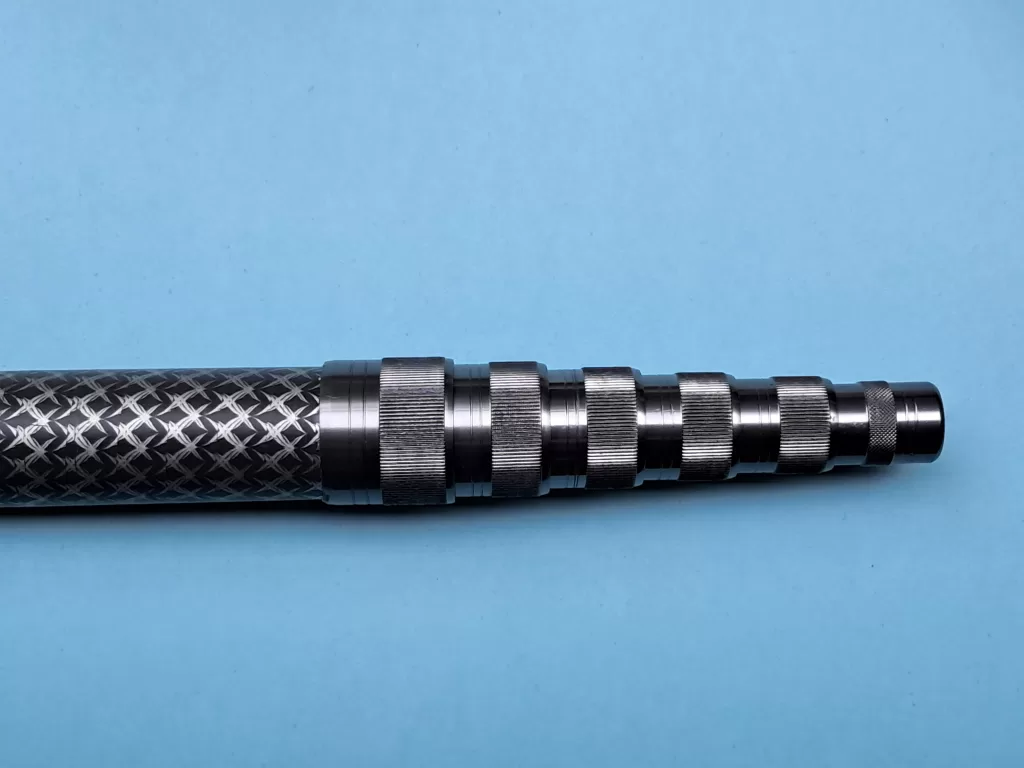
Friction locking occurs as the sections are pulled to complete extension. This is fine for fishing or harvesting; the pole is essentially being utilised in tension. This enhances the friction locking for these activities. Antennas though, just to be difficult, tend to impart a compressive force on the pole which of course works against the friction lock. Most pole owners have at some stage experienced the unmistakeable sound of an extended upright pole packing itself for transport. Even worse, the rate of descent of the pole sections can cause significant damage to the pole, which can result in a crushed enthusiasm for portable activities.
Considerable discussion over coffee from MP members has resulted in a number of trials to enhance the locking of the pole sections in the extended form. These range from external spring clips, and jubilee clip bands lined with various “grippy” materials, “O” rings and tye-wraps. Applying such a retainer at the base of each extended section, should disallow the sections collapse. And some of these have worked well.
In general, no spring clip provided enough resistance to hold its position. They would simply slide on the pole section, if the section decided to collapse. “O” rings are very effective, especially when stretched tightly. If there is any collapsing movement, the “O” ring is squeezed into the gap between sections and creates a lock that works with the compression force. Unfortunately, “O” rings are typically not intended to be stretched significantly, and they tended to snap and make their escape after a couple of days. Jubilee clips lined with a soft plastic have proven quite effective, as have reusable tye-wraps covered in a length of latex rubber tubing.
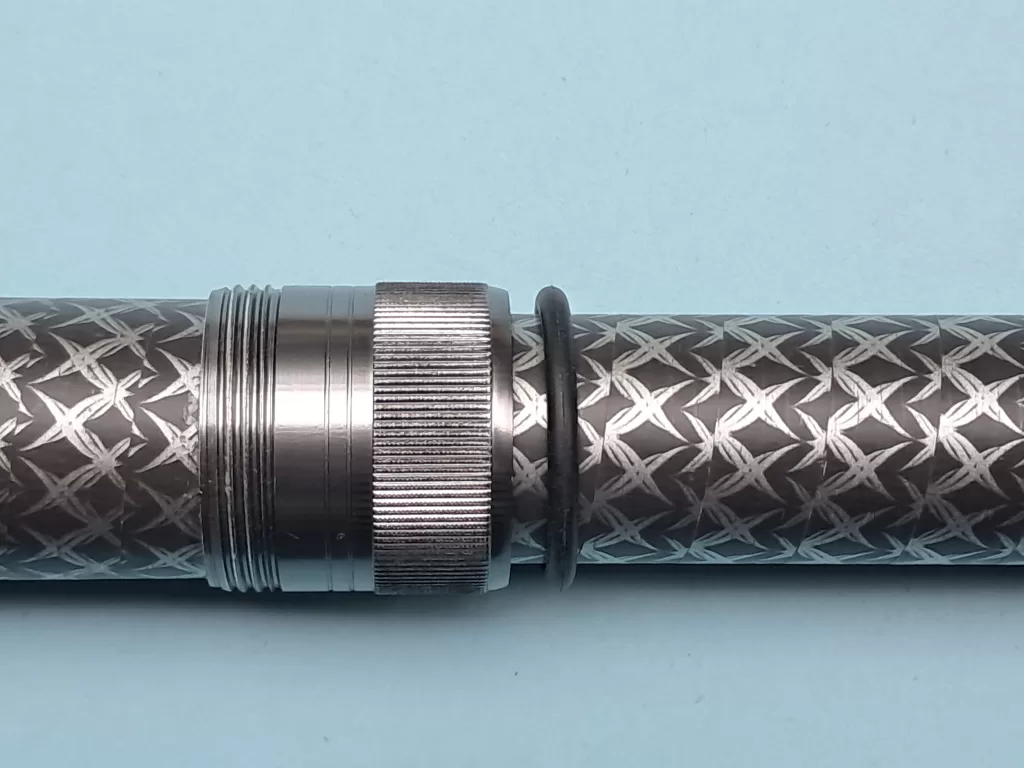
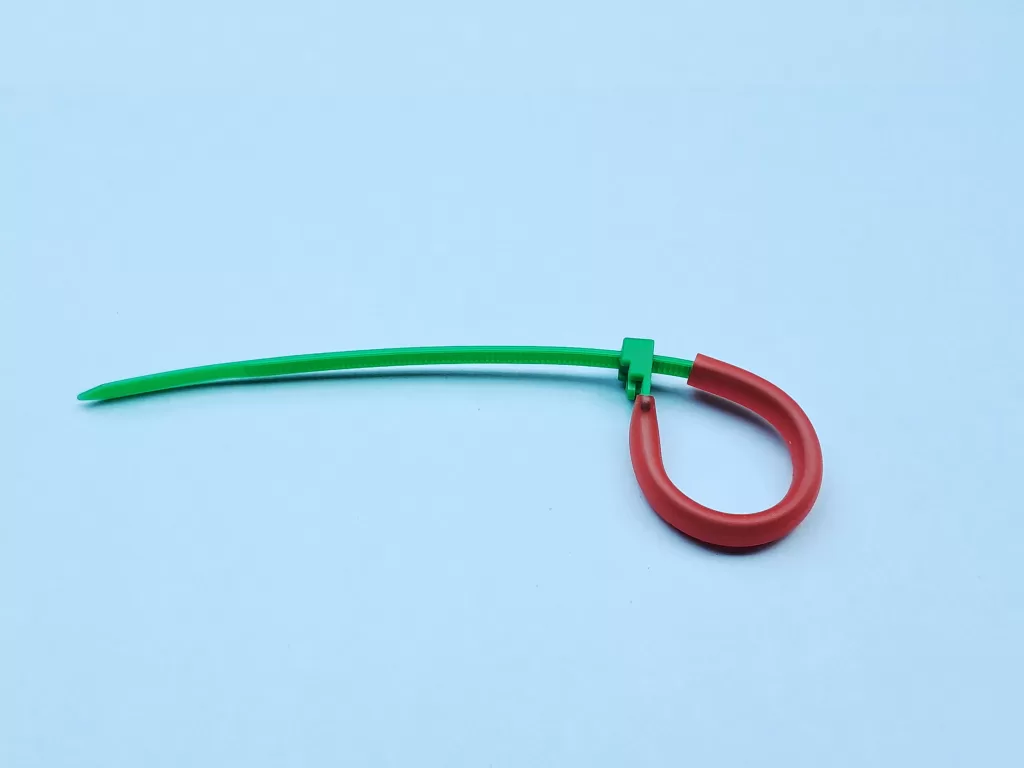
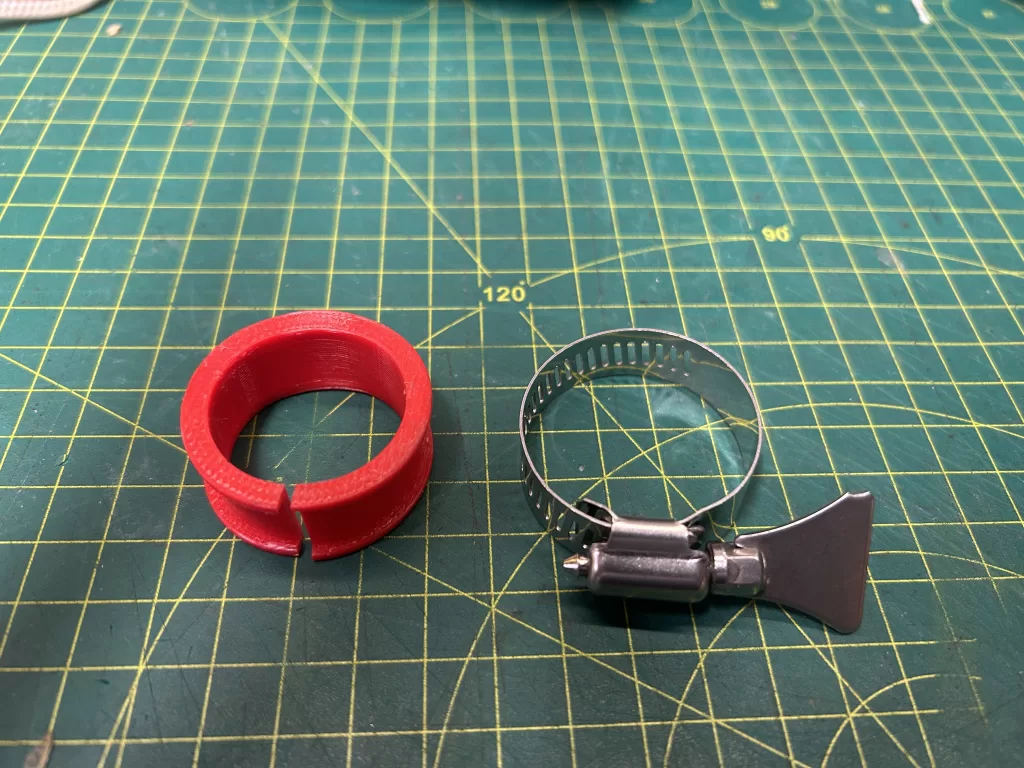
The slight downside to clamping devices, is storage and application of them. Depending on the pole design, leaving the clamps on the pole can restrict the tidy storage of the pole sections.
So another tack, was to consider the problem from the inside. If one could insert some sort of continuous rod inside the extended pole, then the pole shouldn’t collapse. The first iteration of such a support was made from multiple 1 metre long, 4mm dia fibreglass rods. To make a single support length, M4 threaded couplers were glued on each end of the individual rods. Six rods (with one trimmed to length as required) were then assembled to make a support for a 6m carbon fibre pole. Buffers were added to each end of the assembled rod to increase the contact area. The rod was inserted into the extended pole and found to be highly effective against pole collapse. A couple of cm reduction of effective support length occurs with the slight bending as the rod shapes itself within the confines of the pole ID.
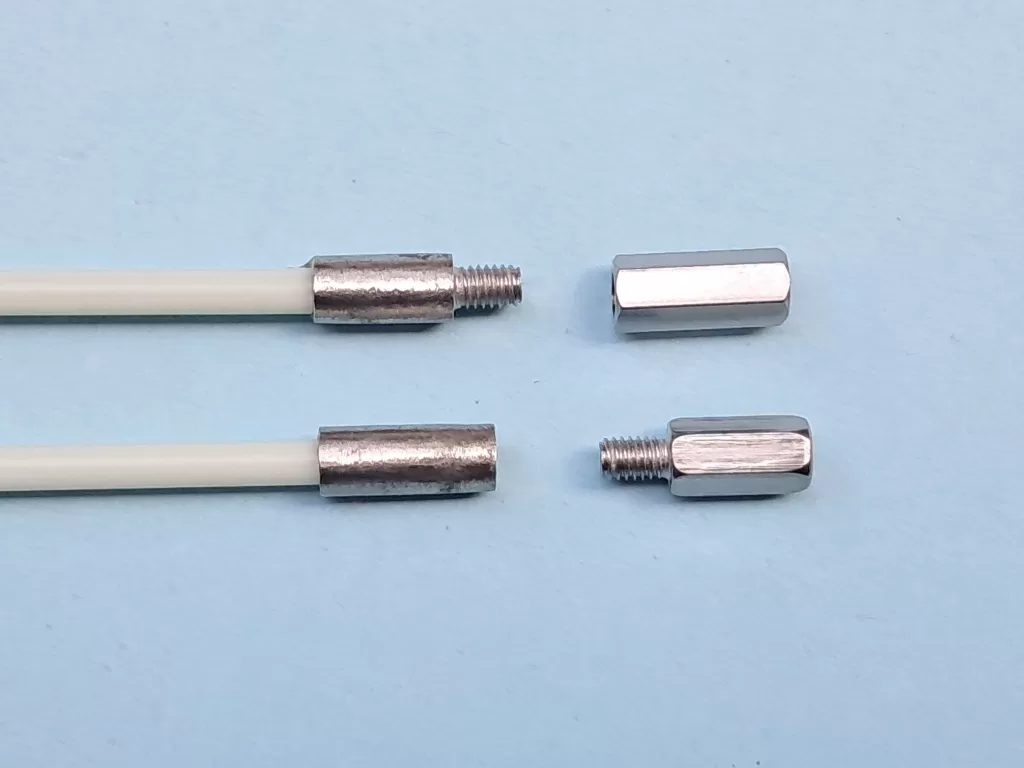
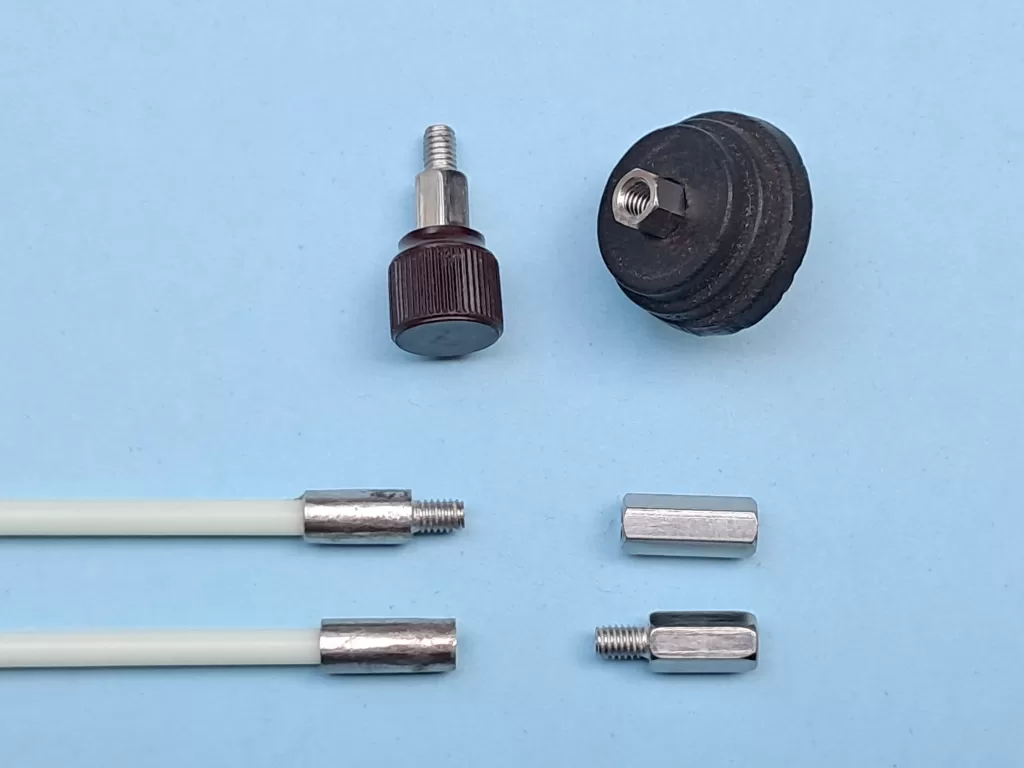
The short rods were chosen, to provide for ease of transport. Indeed the design intention was to store the rods inside the collapsed pole, for “no additional items” to carry. The pole (top) section with the smallest ID of around 13mm set the limit for storage of the rods. The couplers glued to the rod ends, had a hex shape external profile. This increased the effective diameter somewhat. This extra width made it a little difficult to insert all 6 rods, so the couplers were shown the grinder and the new slimmer versions resulted. So all 6 rods can now be stored inside the pole, with relative ease. It would seem that a slight drawback to this support mechanism, is the limitation on the number of rods that can be stored internally – it would seem that 6 rods for a 6m pole is probably the maximum. Another potential downside especially for longer poles is the requirement to fully extend the pole to insert the rod. The pole would have to lifted from horizontal, whereas larger poles are often extended while vertical.
Ongoing Developments
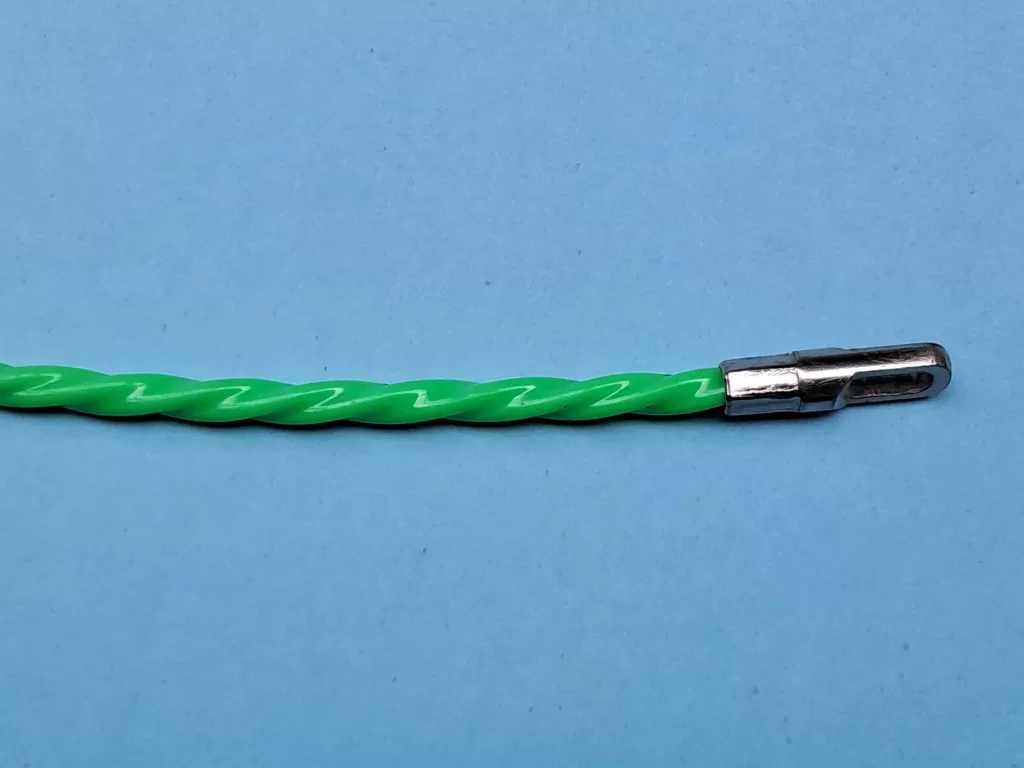
- Yet to be trialled, is a single piece rod. Of course, such could make storage and handling somewhat difficult, so we’ll make it a rollup rod. This requires a suitable combination of axial rigidity and flexibility. This we found it in the form of a tri-lobal cable snake. The tri-lobal form has the appearance of 3 twisted strands, but is actually a single one with a cloverleaf like cross section. This has much better rigidity than the cable snakes that are constructed made from either a single or 3 individual twisted strands, but is still easily coiled up for storage. We anticipate a little more internal flexing, than the fibreglass rods, potentially resulting in a couple more cm initial pole compression, it may be that we can pre-load some of this internally constrained flexing. Just waiting on a new 8 m pole and a suitable cable snake – stay tuned!
- Investigation into O-ring materials suggest good elasticity might be obtained with O-rings made of VMQ. Some are on the way and will be trialled as soon as they are available!