
H night time again and what better than to start off with a BBQ lunch? After all there was half a day and several hours of night ahead that required fuelling…
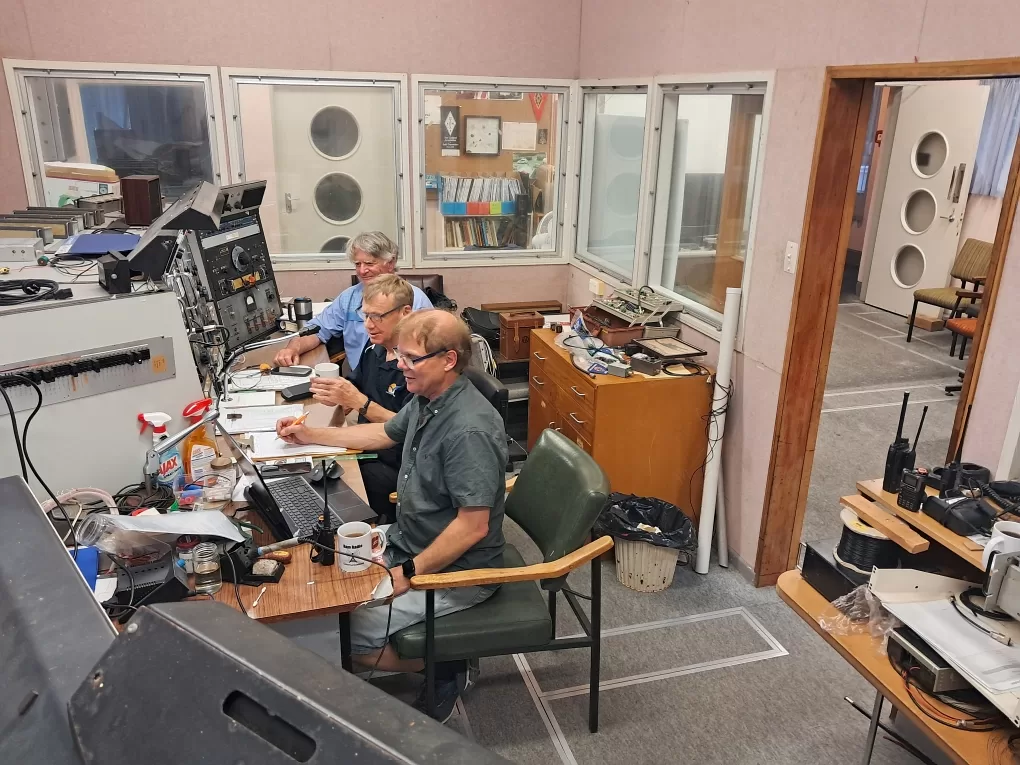
Start time 19:30 came around and the trio of Martyn ZL3CK, Steve ZL1FS and Rob ZL4ROB got the MP participation under way. Signals were somewhat subdued in the first half hour period ( not surprising given the relatively early time ), but subsequently conditions improved somewhat. This year we had sufficient members present to allow a different crew to operate each period. Although conditions improved during the evening, we were constrained to a single operating frequency ( using the crystal controlled vintage RCA transmitter ) and so potentially missed a number of possible contacts on other frequencies. Regardless, it was a fun event.

Early in the evening, Rob ZL4ROB was monitoring activity via a number of SDRs, when it became apparent the local KiwiSDR had (again) become deaf. On initial investigation, a protection lamp in the Energy Limiting Device (ELD) had burnt out and the inside of the glass was black. We decided to leave the antenna feed to the Kiwi disconnected for the duration of H night. Previously, we had tested the ELD with a kW carrier being transmitted on 40m, but had not trialled the lower power ( around 230W carrier ) 80m RCA. In fact the 80m antenna is orientated at a similar angle to the SDR rx antenna – with a partial overlap of only a few metres spacing… The 40m antenna is nearer to perpendicular to the SDR antenna and probably doesn’t have such a high level of mutual coupling.
The ELD blown lamp was replaced and the protector reconnected to the antenna, and the output to the SDR was left disconnected while transmissions related to H night continued. At the end of the night, the SDR the was reconnected. A strange burning smell in the area was noticed, but no obvious source was located. We went home.
The following morning, the SDR was trialled, and found to be rather insensitive. Further investigation would have to wait until the following Wednesday.
Wed 11/12/2024
On opening the ELD, it was discovered that the replacement lamp was open. While the lamp glass wasn’t blackened, as per the previous lamp, the lamp had been installed while the 80m transmissions from the RCA were still occurring. The reason for the burning smell noticed at the end of H night also became apparent. The two resistors in shunt with the clamping diodes were cooked. Initially, this didn’t make any sense, as the voltage across them would be clamped by the diodes to a very low ( non resistor cooking ) level. The diodes were found to be OK.
A trial transmission from the 80m RCA transmitter soon shed some light on the puzzle. Red light.
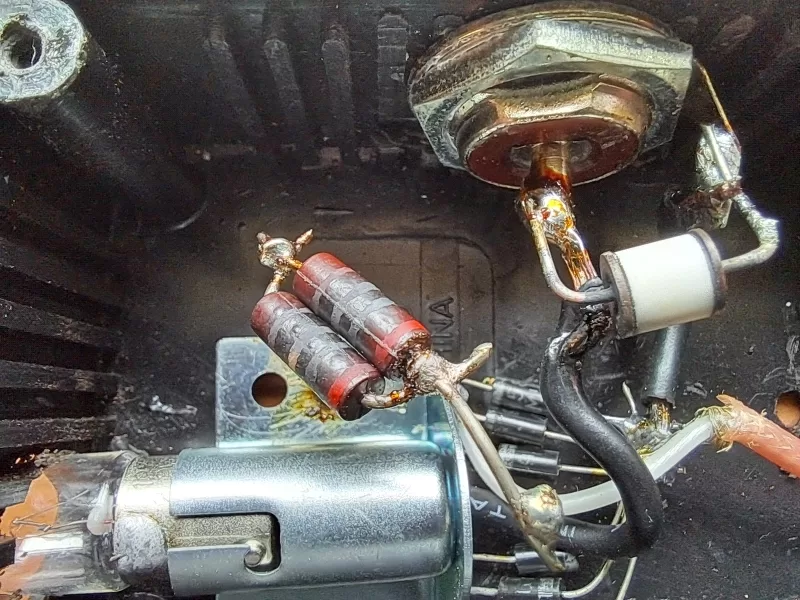
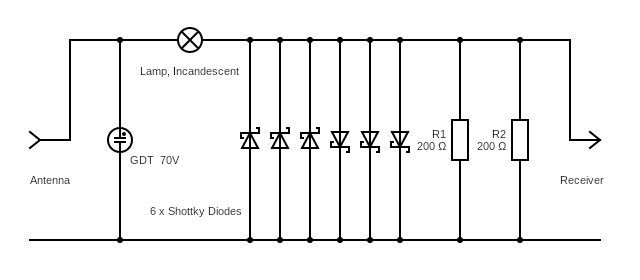
The Gas Discharge Tube (GDT) at the input of the ELD is intended to clamp off very short duration, high voltage spikes ( i.e. potentially kV pulses for nanoseconds. ). The GDT has an extremely high resistance until the voltage across it reaches it’s trigger level – in this case 75v. When the voltage exceeds the trigger level, the gas inside the tube ionises and the voltage drop across the tube falls ( to around 10v ). In the case of a short pulse, when the pulse is finished, the gas ionisation extinguishes and the tube goes back to the high impedance state.
However, it seems that with the picked up RF, we had sufficient level to trigger the GDT into conduction. With substantial power available from the RF, the ionisation in the GDT progresses to an arc and the RF maintains the arc and is dissipated in the GDT – with the result the GST literally glowed red hot. Not quite the intended mode of operation… The resistors that had burnt up, were physically near the GDT and were toasted by the glowing ceramic of the GDT – not by unexplainable self heating. Don’t you love it when there is a sensible explanation to a situation?
So replacement resistors and GDT puts the ELD back in service – but the real problem of high induced power from antennas in too close a proximity to the KiwiSDR antenna remains. Work has ramped up on providing a receive antenna for SDR’s further away from any transmitting antenna. Stay tuned! [ What have I said about those terrible puns? – ED]. In the meantime, the KiwiSDR antenna needs to be removed from the ELD when transmitting using any more than 20W of RF.
What about the remote transceiver?
While not an ideal situation with the remote TX antenna also being close to the Kiwi SDR antenna, we have run tests with the remote TX. It does induce an undesirable level of RF into the Kiwi antenna, however, the RF is adequately diverted / dissipated by the ELD.