
Planned actions for the SDR patch antenna today included lowering the QRM and investigate the substantial Intermodulation Distortion (IMD). A little research provided insight into the role that the coax braid plays with a patch antenna – basically the braid is the antenna. It also transpires that many people have had issues with IMD with the commonly used FET input + emitter follower design for a patch matching circuit.
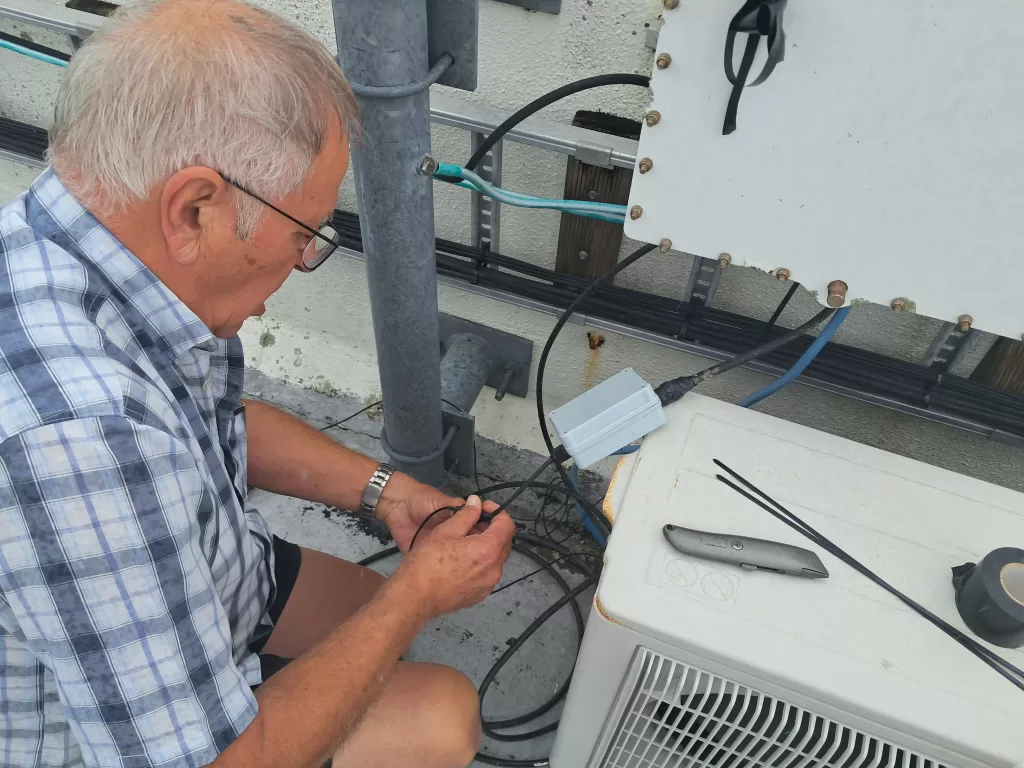
First up – the QRM problem. The braid of the feedline coax is very much a receiving part of a patch antenna installation. Our patch antenna is (temporarily) mounted on top of the building with a significant part of the feedline passing internally though the building to the second floor down from the roof. This internal coax is far more likely to pick up local QRM, so we needed to terminate the braid pickup at the roof level. A relatively easily addressed problem; install a feedline choke on the coax. This effectively makes the braid above the choke, part of the antenna, and the braid below the choke just plain feedline.
We installed a choke outside at roof level. This resulted in a significant reduction in the QRM previously experienced. It also lowered overall signal levels, as now the effective part of the coax that was acting as antenna was only around 2m in length. Along with signal level reduction, there is also significant noise level reduction, so we may still be ahead. The part of the coax acting as antenna should be significantly longer; and it will be if the “patch” antenna proves worth deploying.
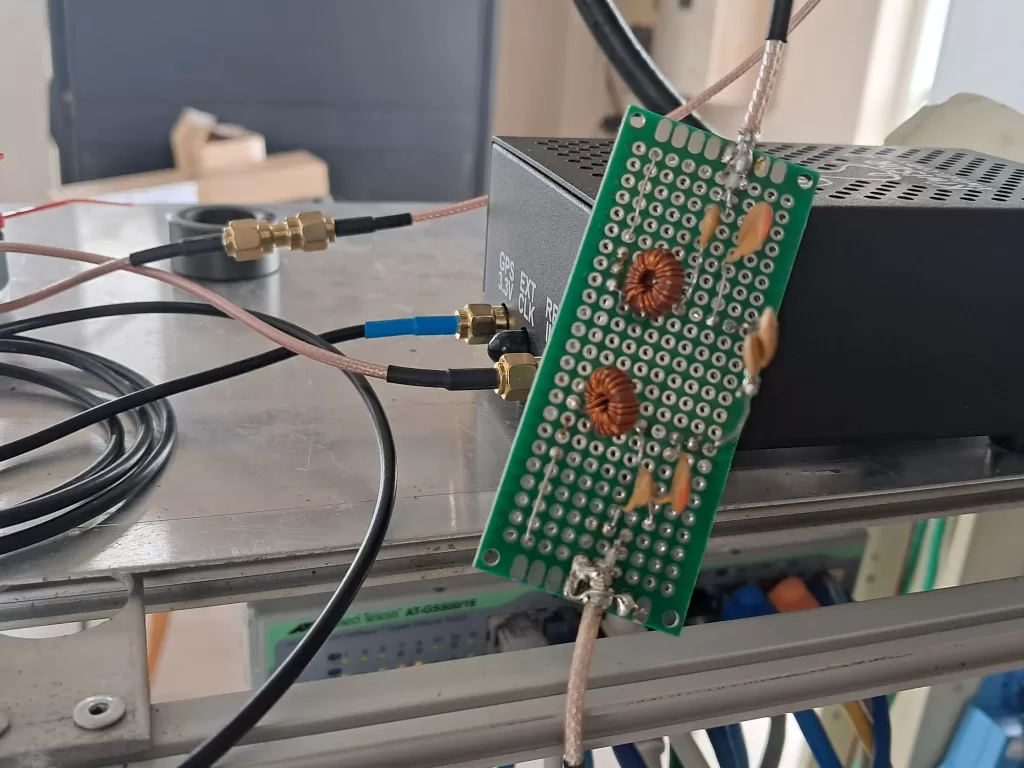
Previously, we had discovered unacceptable IMD, apparently originating from patch electronics, but overloading the Kiwi SDR. AM broadcast stations individually registered at around 50dB / S9 on the KiwiSDR when using the patch antenna – significantly more than when using the larger wire dipole! Of course, a number of signals of 50dB/9 together add up to a significantly higher level; so the AM BC stations need to be brought under control. It was earlier found that adding an attenuator in the antenna feed to Kiwi, controlled the overload. Of course an attenuator lowers all signals, so a notch reject filter for AM broadcast stations is really the ideal. A rough and ready high pass filter was settled on for todays testing, as it could be constructed much faster than a notch filter. The filter substantially reduces the AM BC signals and lower frequencies, as seen by the Kiwi SDR.
So, with QRM reduced noticeably and overload of the Kiwi SDR addressed, we took another look at the IMD vs supply voltage characteristics of the patch antenna electronics. Strangely, there was significant noise at 9v, much less at 12v and gross noise at 15v ! The lowest noise appeared to be with a supply voltage of around 11v.
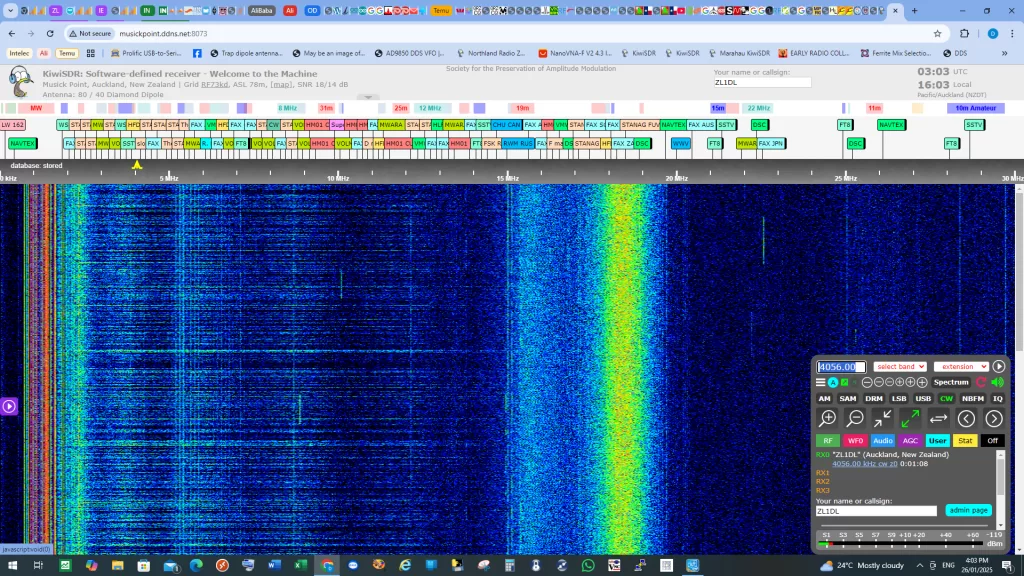
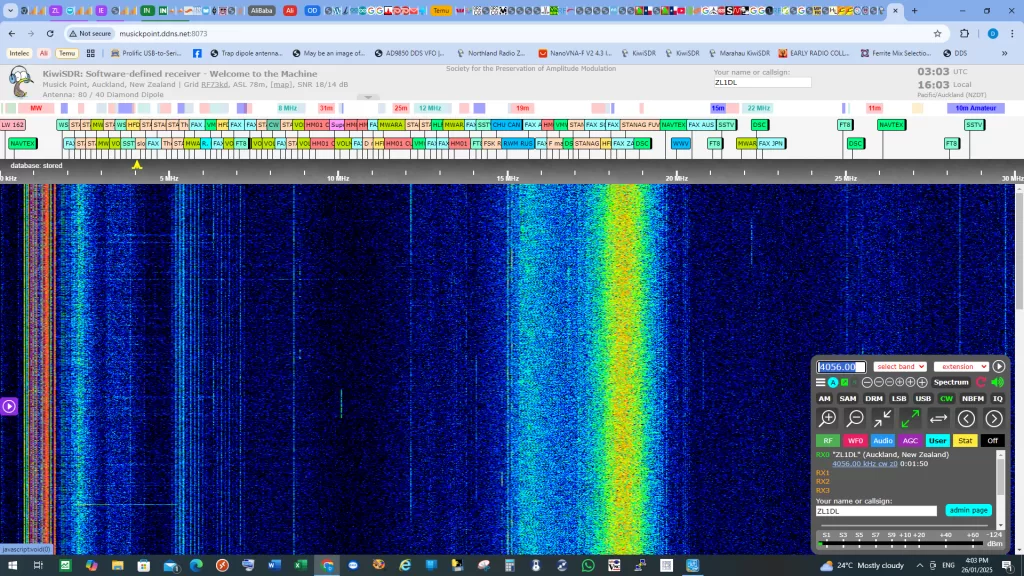
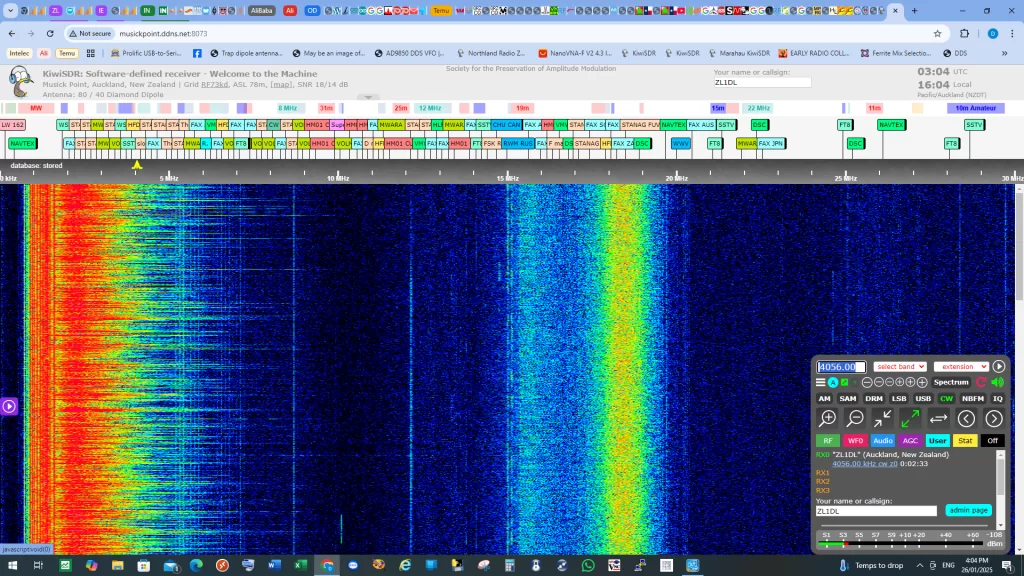
Currently, the Kiwi SDR is much quieter with a lower average noise level, but desired signals are also significantly down. Further testing will include extending the external coax length, to increase the effective antenna size. Also further investigation into the rather “unstable” patch electronics is required. Several articles have suggested redesigns of the circuit to improve IMD. Something to mull over coffee…